LAKE SEBU: WHERE NATURE BECAME A WAY OF LIFE

Long before Lake Sebu became known as a destination, its lakes, rivers, forests, and mountains were already part of the everyday life and heritage of the **T’boli people**.
The T’boli traditionally live around the highland lake system of Lake Sebu, Lake Seloton, and Lake Lahit. These waters and the surrounding mountains have provided food, livelihood, and a place to build communities for generations.
Today, when we visit Lake Sebu, we see beautiful scenery. But behind that scenery is a deeper story of people, nature, survival, and tradition.
💧 THE THREE LAKES OF LAKE SEBU
At the heart of this landscape are **three interconnected highland lakes:**
🌊 Lake Sebu
🌊 Lake Lahit
🌊 Lake Seloton
These lakes are part of a natural water system surrounded by mountains and forest. Water from the lakes eventually flows through the "Seven Falls", continuing downstream through the river system.
For the communities living around them, the lakes have never been simply beautiful bodies of water. They are sources of food, livelihood, and life.

🐟 TILAPIA — A SOURCE OF FOOD AND LIVELIHOOD
One of the resources most closely associated with Lake Sebu is "Tilapia".
Fishing has long been part of life around the lakes, and Tilapia aquaculture eventually became an important source of livelihood for many families in the area. Research documents Tilapia culture in Lake Sebu beginning in the 1970s, developing into an important part of the local economy.
There is also a fascinating sense of wonder in local stories about the lake's abundant fish — the feeling that the waters continually provide.
Rather than simply calling the Tilapia an “unlimited resource,” it is more meaningful to understand the story as a reflection of how generations have regarded the lake as a generous source of food and livelihood.
Today, Tilapia remains one of the most recognizable products of Lake Sebu.

🐚 KETENG — A SMALL TREASURE IN THE RIVERS
The lakes are not the only source of food.
In the rivers and waterways around Lake Sebu, particularly in areas near the waterfalls, people have also gathered small freshwater shells locally known as “keteng.”
These tiny freshwater shells may seem insignificant, but they represent something important in the story of traditional life:
**Knowing how to find food in the natural environment.**
Instead of depending only on one source, communities made use of what the lakes, rivers, forests, and mountains could provide.
The search for Keteng meant going into the water and looking among the rocks and riverbed — a simple practice connected to the traditional relationship between people and their environment.

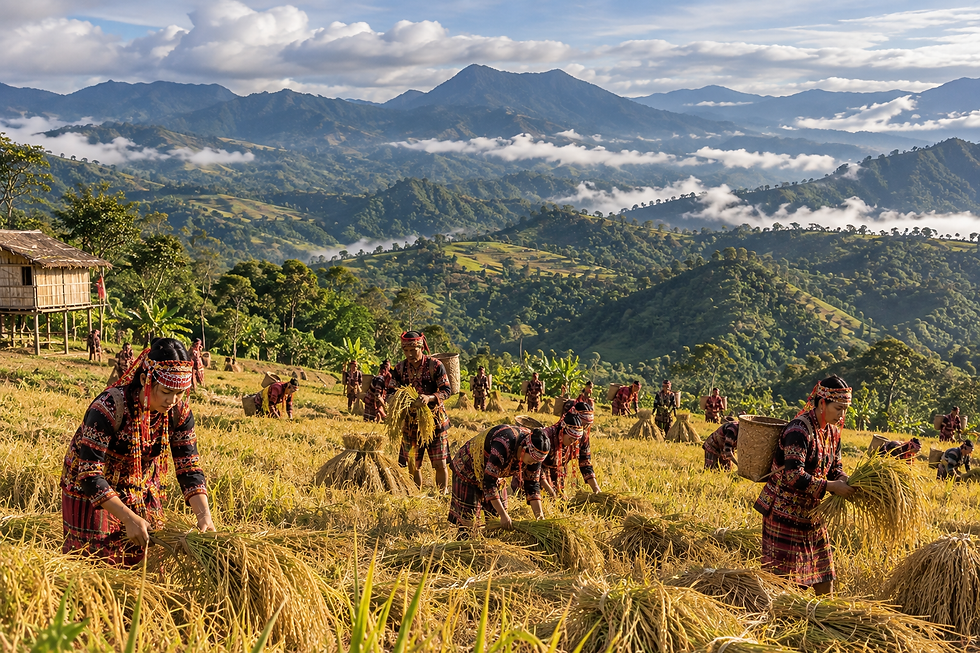
🌾 THE MOUNTAINS — UPLAND RICE
Away from the lakes and rivers, the mountains and upland areas have also provided an important source of food.
The T’boli traditionally practiced upland farming, cultivating highland or upland rice, known in T’boli sources as "Teneba" (Kaingin). UNESCO's documentation describes highland rice as a staple food among the T’boli.
Research on traditional upland rice farming in Lake Sebu found that many communities cultivated rice primarily for their own consumption, while also growing crops such as taro, mungbean, ginger, sweet potato, cassava, corn, and other crops.
For many families, rice was not simply a crop. It was food for the household, knowledge passed from one generation to another, and part of their agricultural heritage.
Some traditional farming practices continue today, while communities are also working to preserve and recover traditional upland rice varieties that were once at risk of being lost.
🌊 THE SEVEN FALLS
And then there are the famous 7 Falls of Lake Sebu.
The waterfalls are part of the natural flow of water from the highland lakes.
They are traditionally known as:
🌊Hikong Alu - Passage
🌊Hikong Bente - Immeasurable
🌊Hikong B’lebed - Zigzag
🌊Hikong Lowig - Booth
🌊Hikong K’fo-i - Wild Flower
🌊Hikong Ukol - Short
🌊Hikong Tonok - Soil
Each name carries meaning, and together the Seven Falls form an important part of the landscape and cultural identity of Lake Sebu.
The waterfalls are not merely something to photograph.
They are part of the same natural system that connects the mountains, rivers, lakes, forests, and communities of Lake Sebu.

🌿 THE STORY OF LAKE SEBU IS A STORY OF SURVIVAL
When we look at Lake Sebu, we see:
💧 Three lakes
🐟 Tilapia from the waters
🐚 Keteng from the rivers
🌾 Upland rice from the mountains
🌊 Seven waterfalls
🌳 Forests and natural resources
🏡 Communities built around the landscape
But behind all of these is something much deeper.
For generations, the T’boli have learned to live with the land and water around them, fishing, farming, gathering food, creating communities, and preserving knowledge handed down by their ancestors.
This is why Lake Sebu should not be seen only as a beautiful destination.
It is a living landscape.
A place where the lake provides food.
Where the mountains provide farmland.
Where rivers provide additional resources.
Where waterfalls carry the water onward.
And where culture continues to live alongside nature.
🌿Lake Sebu is not just a place you visit 💚
It is a place with a story — a story of nature, heritage, livelihood, and generations of people who learned how to live from the land and water.
📍 Lake Sebu, South Cotabato, Philippines
Shared by WanderSox Adventures as a cultural and educational story about Lake Sebu and the T’boli communities. Some traditional stories and oral histories may vary between communities.

Where Tradition Meets the Lake
Written by WanderSox Adventures
Culture & Heritage • Lake Sebu, South Cotabato


Comments